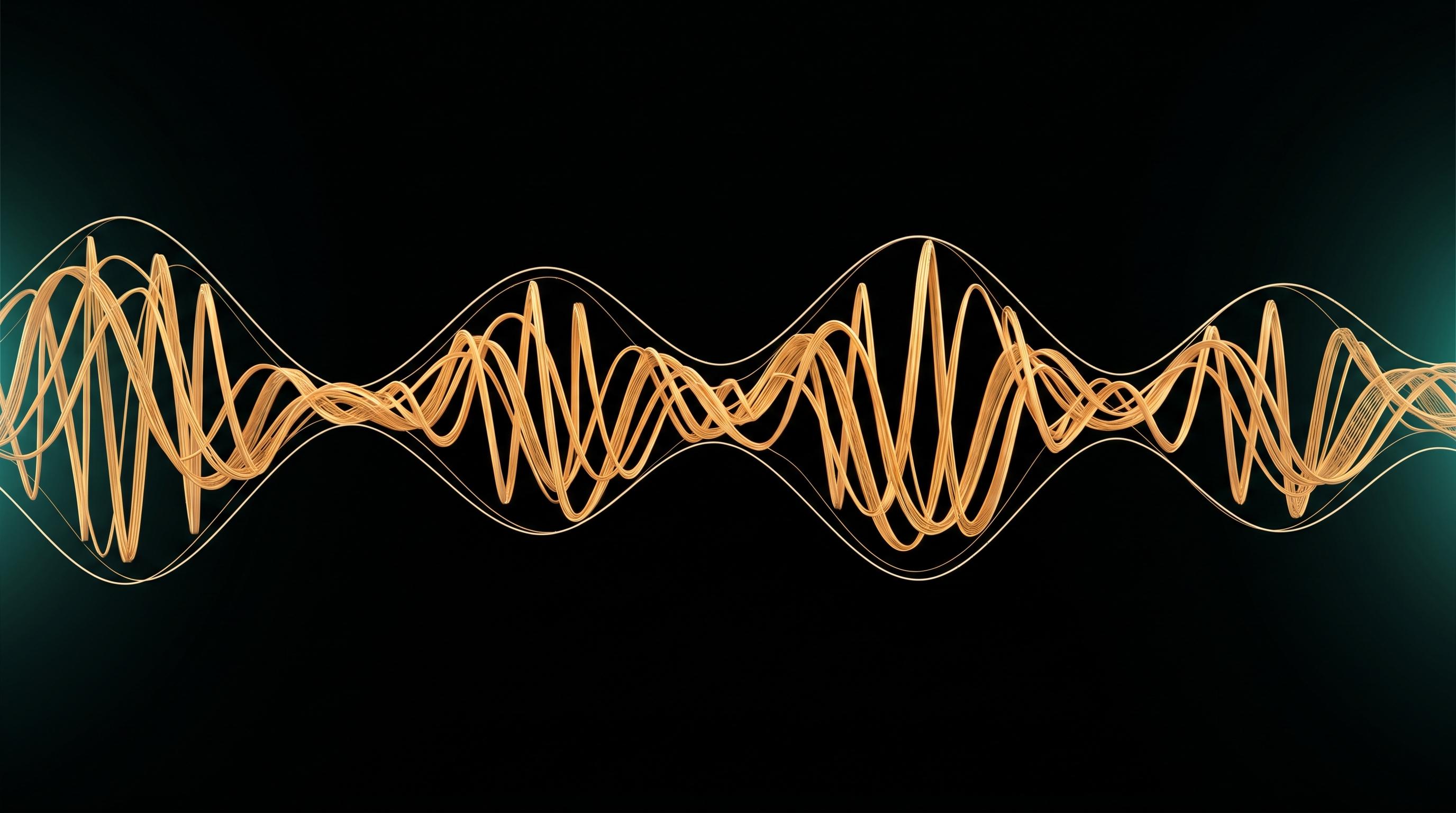
Monaural beats are two nearby tones mixed into one sound before it reaches you. Play 200 Hz and 210 Hz together and the result is a single tone whose loudness pulses 10 times a second. Because the pulse is physically in the sound wave, it plays through ordinary speakers. On EEG it usually draws a larger brain response than a binaural beat (Schwarz & Taylor 2005). The outcome evidence is thin. In 25 adults, five minutes of monaural beats lowered state anxiety compared with a plain tone (d = 0.39 to 0.61, Chaieb 2017). In the largest trial, 308 adults, anxiety fell only in the group that heard the beats inside music (d = −0.58, before versus after). Beats on their own left it unchanged, and a plain tone nudged it up (Venkatesan 2025).
That last result is easy to miss, and it changes how you should use them. This page grades every outcome study we could find, then ends with a two-week test you can run at home.
What are monaural beats?
They come from a very old piece of acoustics. When two tones sit a few hertz apart, their waves drift in and out of step. In step, they add together and the sound gets louder; out of step, they partly cancel and it gets softer. What you hear is one tone, pitched between the two, swelling and fading at the difference between them. Anyone who has tuned two guitar strings that are nearly, but not quite, in tune has heard it: the slow wah-wah that speeds up the further apart the strings drift.
A monaural beat is that effect, made on purpose at a chosen rate. Mix 200 Hz and 210 Hz and you get a tone around 205 Hz pulsing at 10 Hz, the speed of the brain's alpha rhythm.
The name is slightly misleading. You usually hear monaural beats with both ears. "Monaural" means the beat is complete in the signal each ear receives, so one ear alone is enough to hear it. That is the whole difference from the famous sibling:
- Binaural beats send 200 Hz to one ear and 210 Hz to the other. Neither ear hears a beat; your brainstem combines the two and perceives one. That only works on headphones. We compare the two in depth in monaural vs binaural beats.
- Isochronic tones skip the second tone entirely and switch a single tone on and off. They are the third member of the family, covered in what are isochronic tones.
How do monaural beats affect the brain?
When a sound pulses at a steady rate, the auditory system produces electrical activity at that same rate. It shows up on EEG, the scalp recording of the brain's electrical activity. Researchers call it the auditory steady-state response. It is the measurable core of what the wellness world calls "brainwave entrainment."
Monaural beats produce that response strongly. In Schwarz and Taylor (2005, Clinical Neurophysiology), a 40 Hz binaural beat drew a smaller response than the same beat delivered monaurally. Once the tones rose above 3 kHz, the binaural response disappeared, while the monaural one held at low and high frequencies. Fifteen years later, Orozco Perez and colleagues (2020, eNeuro) found the same pattern. Both beat types entrained the cortex, and binaural beats did so only weakly compared with monaural beats. The pattern is not universal. At 6 Hz, Scala and colleagues (2025) found that only the binaural beat entrained cortical activity at the beat frequency, in 20 adults.
The 2020 study (PMID 32066611) also carries the caveat that matters most here. The researchers chose monaural beats as their control because, in the paper's words, they are "known to entrain brain activity but not mood," a premise taken from earlier work. Their own data fit it. The 16 listeners rated their mental relaxation and absorption after each block, and the ratings did not differ between the beat conditions and an eyes-closed baseline. The cortex followed the beat; how people felt did not measurably change.
So a strong EEG response tells you the ear and cortex are tracking a rhythm. It does not, by itself, tell you anything about calm, focus or sleep. Those questions need outcome studies, and there are not many.
What can monaural beats actually do?
A PubMed search for "monaural beat" in titles and abstracts returned 23 records on 28 September 2026, reviews and editorials included. The table below covers every study among them that measured how people felt, performed or slept; the EEG-only papers, the reviews and one re-analysis of earlier data are left out. The tiers are ours. 🟡 marks a positive result that has not been replicated. ⚠️ marks a result that points the wrong way. ⚪ means it was tested and nothing was found. State anxiety means how anxious you feel right now, not your usual level, and d is a standard effect size: roughly 0.2 is small, 0.5 medium and 0.8 large.
| Question | Study | What happened | Our read |
|---|---|---|---|
| Short-term anxiety | Chaieb et al. 2017: 25 healthy adults, 5 minutes per condition, over-ear headphones | State anxiety lower after 6, 10 and 40 Hz beats than after a plain control tone (d = 0.39 to 0.61); no difference between the three frequencies | 🟡 Emerging |
| Anxiety, beats inside music | Venkatesan et al. 2025: 308 adults randomized, 30 minutes | Beats plus music lowered anxiety (d = −0.58, before versus after) and lifted mood; beats alone left anxiety unchanged and reduced energy (d = −0.28); a plain tone raised anxiety (d = +0.24); no music-only group | 🟡 Emerging, and the beats' own share is untested |
| Relaxation, same music with and without beats | Chang et al. 2023: 8 adults; every author works for the company developing the product | Some relaxation ratings rose only with the beat-modified music, not with the same music unmodified | 🟡 Tiny and industry-run |
| Relaxation ratings | Orozco Perez et al. 2020: 16 adults | Beats entrained the cortex; ratings of mental relaxation and absorption did not differ from an eyes-closed baseline | ⚪ Nothing found |
| Attention speed | Engelbregt et al. 2019: 24 adults, 40 Hz | Faster on an attention task than with white noise, exactly like binaural beats; accuracy and working memory unchanged | 🟡 Emerging |
| Attention accuracy | Engelbregt et al. 2021: 25 students, 40 Hz, 5 minutes | More errors than with pink noise, while binaural beats produced fewer | ⚠️ Points the wrong way |
| Mind wandering | Chaieb et al. 2022: 34 frequent mind-wanderers, theta beats (4 to 8 Hz) during a long task | Less mind wandering than with a plain sine tone; less than silence only in a stricter subgroup | 🟡 Emerging |
| Stress during a long task | Schmidt et al. 2024: sustained attention task | Every sound condition, beats included, rated more distracting and tiring than silence, with bigger rises in stress and negative mood | ⚠️ A downside |
| Memory and vigilance | Chaieb et al. 2017: same 25 adults | No effect on working memory, long-term memory or vigilance | ⚪ Nothing found |
| Long-term memory | Derner et al. 2018: 13 epilepsy patients with implanted electrodes, 5 Hz | Memory ran binaural best, control tone second, monaural last | ⚠️ Points the wrong way |
| Falling asleep | Shumov et al. 2023: 221 people at home | Time to fall asleep the same with monaural beats, binaural beats, or the same sound with no beats | ⚪ Nothing found |
| How pleasant and relaxing they feel | Costa et al. 2024: two studies over loudspeakers, 47 adults rating one-minute clips, then 31 adults listening for 10 minutes | Rated less pleasant and less relaxing than pentatonic music in both studies, and less pleasant than silence in the second | ⚠️ Points the wrong way |
| Anxiety in the dental chair | Bhusari et al. 2023: 45 children aged 6 to 12 in three groups | The monaural group's drop in anxiety missed significance (p = 0.064); the binaural group's reached it | ⚪ Not significant |
Read down the right-hand column and a picture forms. Every positive result is a single, unreplicated study, most of them small, measured over one sitting in healthy volunteers. Nobody has tested weeks of daily listening, and nobody has tested people with a diagnosed anxiety disorder.
Two details matter more than they first appear to.
The frequency made no detectable difference. In Chaieb 2017, theta, alpha and gamma beats all lowered anxiety by similar amounts, with no significant difference between them. If entrainment to a specific brain rhythm were driving the effect, you would expect the frequency to matter. One simpler explanation is that a gently pulsing sound is relaxing to sit with for five minutes, at almost any rate. The same paper found a dip on one mood item, "grief," after the 40 Hz beats. But the overall mood analysis was not significant, and the authors say that result has to be regarded with caution. We used to present it as a finding. It isn't one.
The biggest trial points at the music. Venkatesan 2025 is by far the largest monaural anxiety study, and its beats-only group did not get calmer. Its plain-tone group got slightly more anxious over the same 30 minutes (d = +0.24). The paper's follow-up tests compare each group only with its own starting point. None of them compares the beats-only group with the tone group, so the paper cannot show the beats did any better than the tone. Nor can it tell whether the beats added anything to the music. The authors are plain about that: "the absence of a music-only control prevents us from directly assessing whether the addition of beats enhances the anxiolytic effects of music." Their summary is just as careful. The beats, they write, can be woven into music "without diminishing the anxiolytic properties of the latter": the anxiety-reducing effect they describe belongs to the music.
Worth knowing too: three of the four authors worked for Universal Music Group, and the fourth consulted for it, which the paper discloses. The one study that did play the same music with and without beats, Chang 2023, found some relaxation ratings rose only with the beats. It had eight participants, and every author works for the company developing the product.
Do monaural beats need headphones?
No, and this is their one clear practical advantage. The pulse is already in the sound wave, so a speaker reproduces it as faithfully as a pair of headphones would. A binaural beat, by contrast, only exists if each ear gets its own tone, which speakers cannot guarantee.
That opens up settings where headphones are a nuisance: the car, a pillow speaker, a shared room, a meditation group. Costa and colleagues (2024) played a very slow monaural beat, one pulse every five seconds, through loudspeakers to 31 adults. Compared with silence, their EEG shifted in a way the authors read as relaxation.
One honest caveat. The best-known anxiety result, Chaieb 2017, was measured on closed over-ear headphones at a moderate 60 dB, roughly conversation level. Speakers are supported by the physics, not by that particular trial.
Are monaural beats better than binaural beats?
They usually produce the stronger brain signal (Schwarz & Taylor 2005; Orozco Perez 2020), though not in every study (Scala 2025). On outcomes, the head-to-head results flatter neither side. Both beat types sped up attention equally in Engelbregt 2019. Binaural beats won on accuracy in Engelbregt 2021. And neither changed how fast people fell asleep in Shumov 2023.
The bigger difference is how much has been studied. Binaural beats have a meta-analysis behind them. Garcia-Argibay 2019 pooled 35 effect sizes from 22 studies and found a medium overall effect (g = 0.45) across memory, attention, anxiety and pain. Monaural beats have nothing of that size. Stronger signal, thinner evidence: that is the fair one-line summary, and our side-by-side comparison of monaural and binaural beats walks through when each makes more sense. For the binaural evidence itself, start with the binaural beats topic hub.
Which monaural beat frequency should you use?
Whichever you find comfortable. Since Chaieb 2017 found no difference between 6, 10 and 40 Hz, there is no evidence-based frequency map for monaural beats. The familiar charts, delta for sleep, alpha for calm, gamma for focus, are borrowed from the speeds of the brain's natural rhythms. They are a sensible starting convention, not a tested prescription.
A few practical choices do have some grounding:
- 10 Hz (alpha) is a reasonable first try for winding down. It was one of the three frequencies that lowered anxiety in Chaieb's trial, alongside 6 Hz and 40 Hz.
- Keep the carrier tone low. The carrier is the tone the beat is built from. Chaieb used carriers between roughly 110 and 220 Hz, a warm, low hum rather than a whine.
- Put the beat under something you like listening to. Beats alone were rated less pleasant than pentatonic (five-note-scale) music by the listeners in Costa 2024, and only the music version lowered anxiety in Venkatesan 2025.
- Keep the volume moderate. The beat does not need to be loud to be there.
What are the downsides of monaural beats?
The main one is distraction. In Schmidt 2024, people doing a long attention task rated every sound condition, beats included, as more distracting, disturbing, uncomfortable and tiring than silence. Those conditions also came with bigger rises in stress and negative mood. Monaural beats are a poor default for demanding work, and Engelbregt 2021 found more errors on an attention task with 40 Hz monaural beats than with pink noise.
The second is that the pulse itself can grate. It is more noticeable than a binaural beat, and some people simply dislike it. If that is you after a few tries, it is a real answer, not a failure of willpower.
And two standard cautions. If you have epilepsy or a seizure disorder, talk to a clinician before using any rhythmic audio. And none of this is a treatment: monaural beats are a relaxation aid with small, early evidence, not a substitute for care.
How can you test monaural beats on yourself?
The most useful experiment is the one Venkatesan 2025 did not run: one piece of music, with and without the beat. It is easy to do at home, and it answers the question that matters for you, which is whether the beat adds anything to a sound you already find calming.
- Pick one piece of calm music and one monaural beat. Our free generator at monaural.info plays a 10 Hz beat through whatever speakers you have, with no signup and nothing to install.
- Alternate evenings for two weeks. Music alone one night, the same music with the beat underneath the next, for 15 minutes at a similar time.
- Rate your tension from 1 to 10 before and after every session, and write it down. Memory is a poor judge of small differences.
- Compare the two columns at the end. If the beat nights are not reliably better, the music is doing the work, and that is worth knowing.
If the beat does help you, keep it. If it doesn't, you have a clear answer instead of a hunch.
Where does DeepBliss fit?
DeepBliss offers monaural beats as one of four sound engines, alongside binaural beats, isochronic tones and colored noise. Monaural beats play through speakers and sit comfortably under other audio. They can run beneath a colored-noise bed, or beneath spoken words such as affirmations spoken in your own voice. The same four engines sit under the audio session attached to each scene of the DeepBliss vision board. Given the Venkatesan result, the beat as one layer under something you actually want to hear is a more defensible design than the beat on its own.
If you are weighing personalized audio tools more broadly, our roundup of AI affirmation apps covers how DeepBliss compares, including where other apps are simpler.
The bottom line
Monaural beats are real, simple acoustics: two tones, one pulsing sound, no headphones required. They usually drive a clear, strong response on EEG. Whether that response does anything for how you feel is still an open question. A handful of small, single-session studies found short-term calm (Chaieb 2017), and the frequency did not seem to matter. In the largest anxiety trial, anxiety fell only when the beats were inside music (Venkatesan 2025).
So use them the way the evidence suggests: as one quiet layer inside a sound you already like, tested honestly against that sound without the beat. That small experiment will tell you more about your own response than any frequency chart.
Important: This article is for educational and general wellness purposes only. Monaural beats and other audio entrainment tools are not medical devices and are not intended to diagnose, treat, cure or prevent any condition. If you have a diagnosed medical or mental health condition, talk to your healthcare provider before relying on them. Disclosure: DeepBliss offers monaural beats as one of its sound engines and runs the free monaural.info generator mentioned above. None of the studies cited here tested DeepBliss.