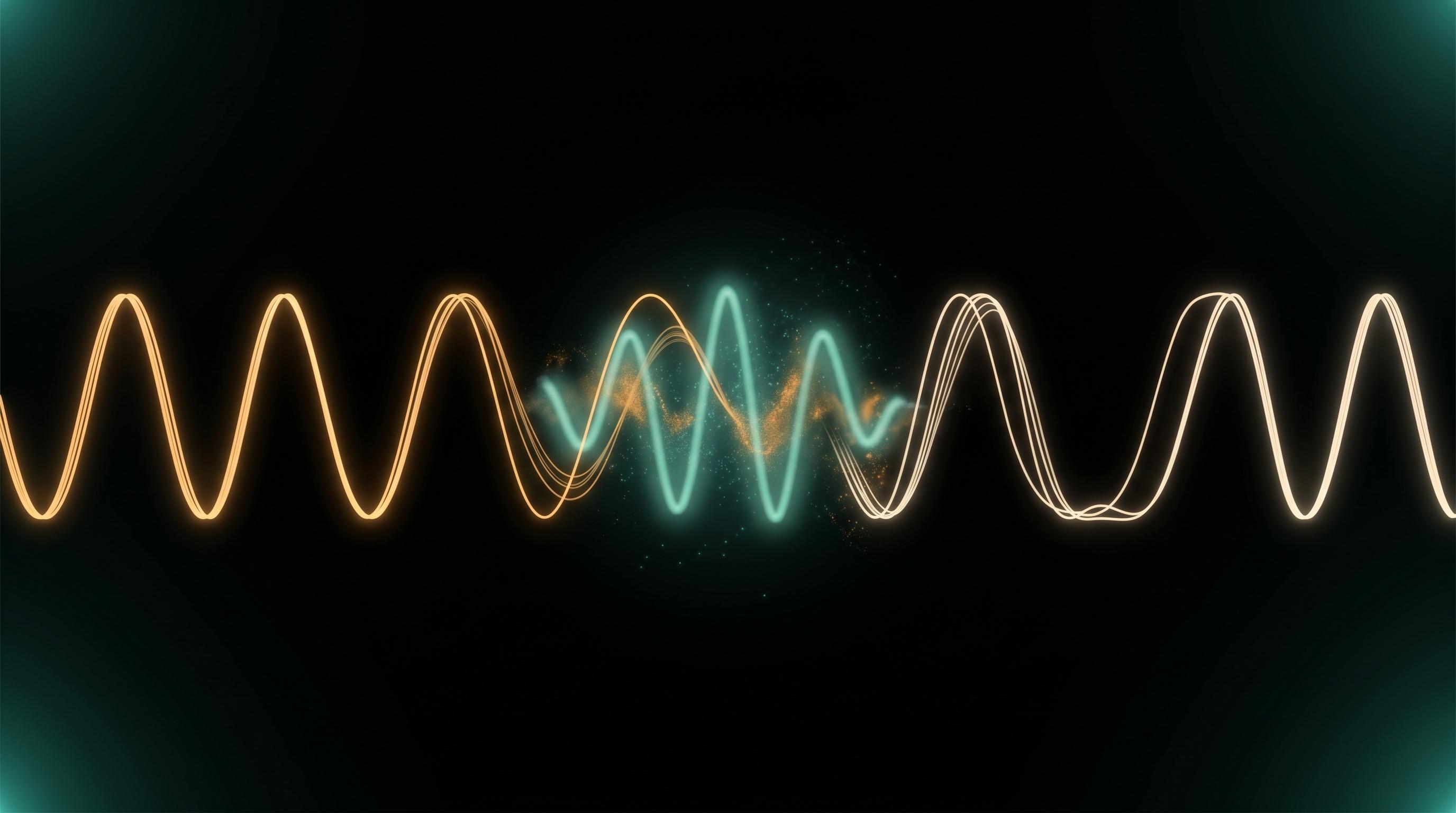
Binaural beats are an audio illusion — two slightly different tones, one in each ear — that may gently guide your brain toward calmer states. The best-supported use is anxiety around surgery: a 2025 meta-analysis of 14 trials found a large but highly variable drop in perioperative anxiety (Xiong et al., n=1,047; PMID 41176178). Across cognition, anxiety and pain, a 2019 meta-analysis found a medium pooled effect (Garcia-Argibay, g=0.45; PMID 30073406). They require headphones, and many people don't respond — so treat them as a low-risk experiment, not a guaranteed fix.
Picture this: It's 11:47 PM, and despite your exhaustion, your mind races through tomorrow's to-do list, replaying today's conversations, worrying about next week's deadlines. You've tried meditation apps, breathing exercises, even counting backward from 1,000—nothing works. Then you slip on headphones, press play on a binaural beat track, and wait to see whether anything shifts. Maybe your thoughts slow down. Maybe nothing changes at all. Both are normal, and the research below explains why.
Binaural-beat research covers cognition, anxiety and pain, with a medium pooled effect in Garcia-Argibay 2019 (PMID 30073406). That pooled result does not establish sleep benefits or validate DeepBliss.
What Are Binaural Beats?
Binaural beats are an auditory phenomenon created when you hear two slightly different frequencies—one in each ear. If your left ear receives a 200 Hz tone and your right ear receives a 210 Hz tone, your brain doesn't hear them separately. Instead, it perceives a third "phantom" tone pulsing at 10 Hz—the difference between the two frequencies.
Your brain builds that beat by comparing the two tones; it isn't in the sound itself (Schwarz & Taylor 2005, PMID 15721080). A separate idea, the brainwave-entrainment hypothesis, says your brain rhythms then fall into step with the beat and drift toward states like relaxation or alertness. EEG studies disagree on whether that happens (Ingendoh 2023, PMID 37205669).
The technology requires headphones to work—each ear must receive its distinct frequency. But once you're listening, the experience is surprisingly subtle. Unlike jarring alarm sounds or harsh white noise, binaural beats blend seamlessly into ambient music, nature sounds, or even silence, creating a gentle rhythmic sensation that most people find soothing rather than distracting.
What the Research Supports, and Where It Stops
Anxiety Reduction
Garcia-Argibay et al. (2019), a meta-analysis of 22 studies, found a medium pooled effect (Hedges' g = 0.45) across cognition, anxiety and pain. That's an average across all three, not an anxiety-specific figure.
Padmanabhan 2005 (PMID 16115248) reported lower preoperative anxiety in a surgical setting. That result does not validate a consumer app or replace medical care.
A short listening session can be a personal experiment. There is no established time-to-benefit for DeepBliss. Monaural beats offer a speaker-compatible alternative.
Sleep: What Delta Beats Can and Can't Claim
A delta-frequency label is not evidence of a sleep benefit.
We are not making a deep-sleep or faster-sleep-onset claim here without a directly identified study.
Deep sleep matters because it's when your body performs essential restoration: muscle repair, immune system strengthening, and memory consolidation. More time in N3 sleep typically means waking up feeling more genuinely rested rather than just "less tired."
A proposed mechanism is not a measured sleep outcome.
Pain Management Support
Research into binaural beats for pain is thinner. A 2025 meta-analysis found binaural beats reduced pain after surgery (Xiong et al., 5 trials, n=433; PMID 41176178), though the trials varied a lot and high-quality evidence remains limited.
Consumer audio is not a substitute for prescribed pain care. Do not change medication based on an audio experience.
The mechanism appears to involve alpha-mediated inhibitory gating: higher alpha activity correlates with lower pain perception, possibly by modulating attention to pain signals and suppressing ascending nociceptive pathways through top-down inhibitory control.
This article does not establish a sustained benefit for chronic pain.
Focus and Gamma: The Weakest Case
Gamma is a frequency label, not a guarantee of improved memory or attention.
Iaccarino et al. (2016, Nature) showed that 40 Hz gamma stimulation reduced amyloid in mouse models of Alzheimer's. That work used light flicker and optogenetics in mice rather than binaural beats, so it tells you little about audio you play at home.
Practical Applications: How to Use Binaural Beats
For Anxiety and Stress Relief
Frequency: Alpha (8-12 Hz, especially 10 Hz) or Theta (4-8 Hz, especially 6 Hz)
Duration: 5-30 minutes
Best Time: During acute stress episodes or as part of daily wind-down routine
Setting: Comfortable seated position, eyes closed, minimal distractions
Try a 10-minute alpha frequency session when you notice anxiety building, and note how you feel afterwards.
For Sleep Preparation
Frequency: Delta (0.5-4 Hz, especially 3 Hz)
Duration: 30-90 minutes
Best Time: 30-45 minutes before desired sleep time
Setting: Lying in bed, lights dimmed, preparing for sleep
Consider incorporating delta binaural beats into your bedtime routine. Start the track about 45 minutes before you want to fall asleep, allowing your brain time to gradually shift toward slower wave patterns associated with deep rest.
For Focus and Concentration
Frequency: Gamma (40 Hz) or Beta (13-30 Hz, especially 15-16 Hz)
Duration: 15-20 minutes
Best Time: 5-10 minutes before focused work, not during
Setting: Comfortable workspace, task-ready environment
The evidence points to listening before a task rather than during it. The 2019 meta-analysis found exposure before (or before and during) a task gave larger effects than exposure during it alone (Garcia-Argibay, PMID 30073406), and one large study found listening during a demanding reasoning test lowered scores (Klichowski 2023; more below).
Integration with Affirmations
Pairing beats with affirmations is a product design choice. It does not establish increased receptivity or reduced resistance. Do vision boards work? discusses the separate goal-setting question.
What the Science Really Says
The most uncomfortable finding in the binaural beats literature isn't that they fail to entrain — it's Klichowski (DOI 10.1038/s41598-023-38313-4) et al. (2023, Nature Scientific Reports, N=1,000), which found that listening during complex cognitive tasks measurably worsened fluid intelligence performance versus silent controls. Everything that follows should be read against that constraint: the anxiety evidence is genuine, but it doesn't generalize to analytical work.
The Entrainment Controversy
Ingendoh 2023 (PMID 37205669) found inconsistent evidence for EEG entrainment. The proposed mechanism remains uncertain.
A measured behavioral result and a measured EEG response are different outcomes; neither establishes the other (Ingendoh 2023, PMID 37205669).
Possible explanations include general relaxation effects, expectation and placebo responses, attention modulation, or changes in functional brain connectivity that don't show up in standard power analyses. The bottom line: binaural beats may work, but perhaps not through the specific mechanism originally proposed.
Individual Variation Is Significant
Response to audio stimulation varies based on individual factors:
- Baseline dopamine: in one study, people with a low spontaneous eye-blink rate (a rough marker of brain dopamine) did better on a creativity task with alpha beats, while people with a high blink rate were unaffected or did worse (Reedijk 2013)
- Personal preference: Some require absolute silence; others need ambient sound
This means binaural beats won't work for everyone—and that's completely normal. Your response depends on your unique neurobiology.
The Cognitive Performance Paradox
Here's where things get interesting and concerning: Klichowski (DOI 10.1038/s41598-023-38313-4) et al. (2023, Nature Scientific Reports, N=1,000) examining binaural beats during complex cognitive tasks found that listening worsened performance on fluid intelligence tests compared to control conditions—a counterintuitive finding that suggests binaural beats may interfere with analytical work.
The researchers suggested that binaural beats might interfere with natural brain wave patterns during active cognitive tasks, creating a mismatch between neural activity and task demands. This doesn't mean binaural beats are harmful, but it does suggest they may not be ideal during complex problem-solving or analytical work.
The takeaway: binaural beats appear most useful for relaxation and anxiety reduction, states where you want to reduce mental activity. For complex cognitive tasks requiring sharp analytical thinking, they may actually hinder performance.
Evidence Quality and Study Limitations
The reviewed EEG literature is heterogeneous and does not establish a reliable entrainment mechanism (Ingendoh 2023, PMID 37205669).
This doesn't mean the findings are wrong—it means we need more rigorous, large-scale studies before drawing definitive conclusions. Current research provides promising signals rather than definitive proof.
The Headphone Requirement
Unlike some audio technologies, binaural beats absolutely require headphones. Each ear must receive its distinct frequency for the brain to create the perceived beat. This limits flexibility—you can't use binaural beats through speakers or while sharing audio with others.
You can prove this to yourself in about ten seconds. Open our free generator at binaural.info, start a beat with headphones on, then take one ear off — the pulse vanishes, because your brain no longer has two frequencies to compare. If headphones are a dealbreaker, isochronic.info and monaural.info are the speaker-friendly alternatives. Our monaural vs binaural beats comparison explains why one survives a speaker and the other doesn't.
Finding What Works for You
Given the significant individual variation, approaching binaural beats as a personal experiment makes more sense than expecting universal results.
Your 14-Day Exploration Protocol
Week 1: Establish Baseline
- Choose one primary goal (anxiety, sleep, or focus)
- Select appropriate frequency based on that goal
- Listen for 15-20 minutes daily at consistent times
- Track your experience: note changes in how you feel, how quickly effects appear, and whether benefits last after listening ends
Week 2: Refine and Adapt
- If experiencing benefits, continue with same parameters
- If not responding, try a different frequency within the same category (e.g., switch from 10 Hz alpha to 8 Hz alpha)
- Adjust duration: some respond better to shorter (5-10 min) or longer (30-45 min) sessions
- Pay attention to volume—binaural beats work best at comfortable listening levels (50-70 dB), not maximum volume
Troubleshooting Common Issues
"I feel more anxious or agitated": You may be sensitive to the specific frequency. Try switching to a lower frequency (move from beta to alpha to theta) or reduce volume. If it consistently feels uncomfortable, trust your experience and explore other relaxation approaches.
"I don't feel anything": Effects can be subtle, especially initially. Look for small shifts—slightly easier breathing, marginally looser shoulders, thoughts moving a bit slower. No study has tested whether effects build over sessions, so judge across several rather than letting one off-day decide.
"It works sometimes but not always": Context matters enormously. Binaural beats work best when you're in a conducive environment (minimal distractions, comfortable position, deliberate intention to relax or focus). They can't override major stressors or physical discomfort.
"I fall asleep too quickly": If using delta frequencies for sleep preparation, this is actually success! If it's problematic for other activities, switch to higher frequencies (theta for relaxation, alpha for calm alertness).
Personalizing Your Practice with DeepBliss
DeepBliss offers presets across four sound types (binaural, monaural, isochronic and colored noise) because the "right" frequency varies by person and goal, and no study can tell you yours in advance.
You can also layer the beats under affirmations in your own cloned voice. Pairing the two is a design choice; no study has tested whether it works better than either one alone.
Try This Tonight: A Beginner's Protocol
Ready to experiment? Here's a simple starting protocol:
For Better Sleep:
- Put on comfortable headphones 45 minutes before desired sleep time
- Choose a delta frequency track (3 Hz) with gentle background sounds
- Lie in bed in your normal sleeping position
- Close your eyes and focus on your breathing—no need to "try" to make it work
- Let the track play for 30-60 minutes (it's fine if you fall asleep during)
- Notice how you feel the next morning compared to nights without binaural beats
For Anxiety Relief:
- Find a comfortable seated position in a quiet space
- Put on headphones and select an alpha frequency track (10 Hz)
- Set a timer for 15 minutes
- Close your eyes and take three slow, deep breaths
- Simply listen—let the sounds wash over you without forcing relaxation
- After 15 minutes, notice whether your breathing has slowed, shoulders have dropped, or racing thoughts have quieted
Remember: You're conducting a personal experiment. There's no "failing" at binaural beats—you're simply discovering whether they work for your unique brain.
The Bottom Line
Treat listening as a personal preference. The pooled cognition, anxiety and pain result (Garcia-Argibay 2019, PMID 30073406) is not a guarantee of an individual benefit.
But they're not a panacea. Evidence quality varies by application, individual responses differ dramatically, and the theoretical mechanism remains debated. They work best as part of a broader approach to wellness rather than as a standalone solution.
What makes binaural beats worth trying isn't that they work for everyone; it's that they're low-risk and accessible, and a two-week personal test costs you very little. For listeners who respond, they offer a simple, non-pharmaceutical way to support calm, though individual response varies significantly.
The real question isn't "Do binaural beats work?"—it's "Do they work for you?" And there's only one way to find out. If you'd rather start from a tool than build your own, our guide to the best binaural beats app for 2026 compares seven, with an honest read of each one's evidence.
Important: This article is for educational and general wellness purposes only. Audio entrainment technologies are not medical devices and are not intended to diagnose, treat, cure, or prevent any disease. Individual results may vary significantly. If you have a diagnosed medical or mental health condition, please consult with your healthcare provider before using audio entrainment technologies.