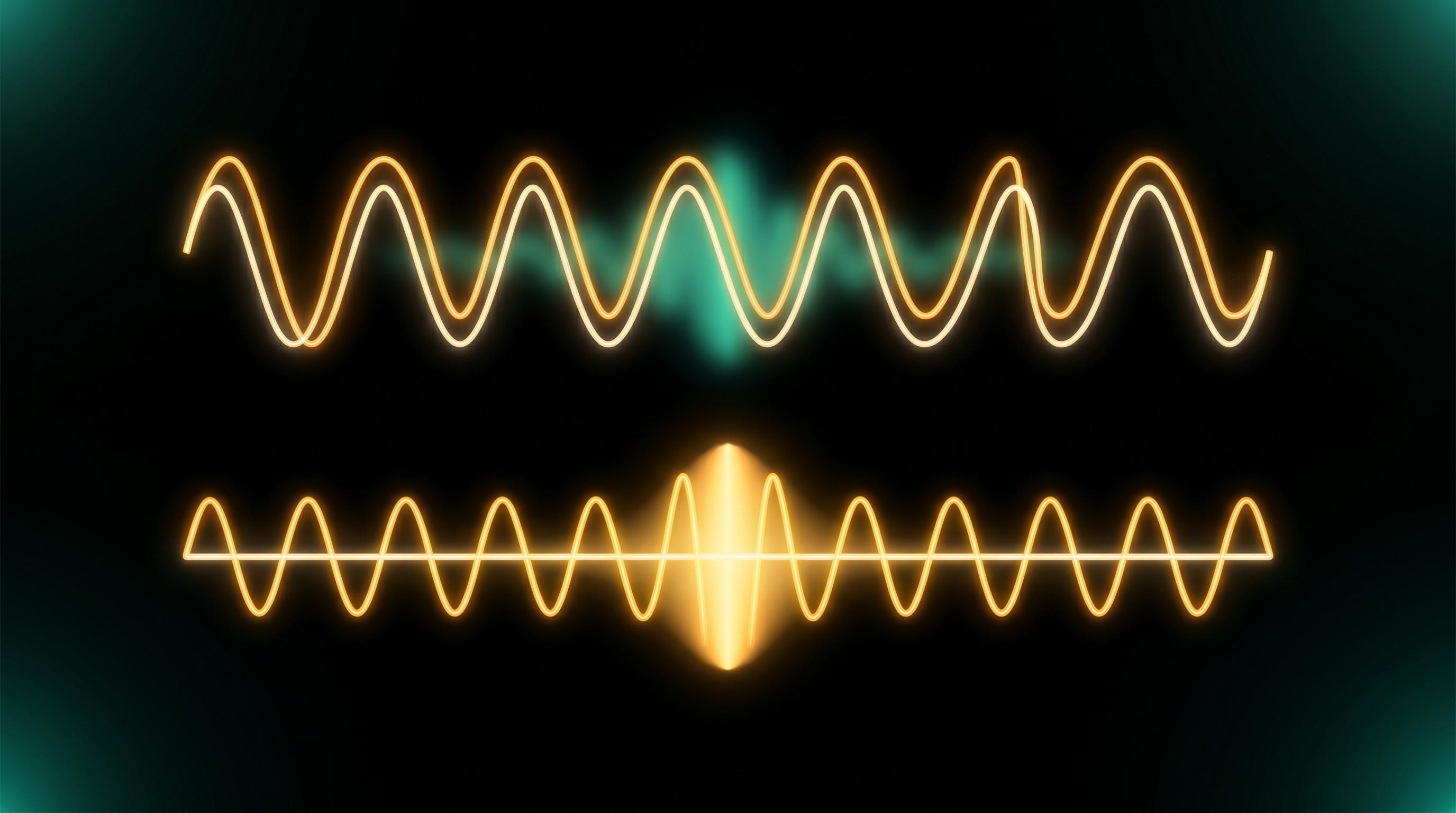
Monaural and binaural beats both create a rhythmic "beat" from two slightly different tones — the difference is where the beat forms. Binaural beats send a different tone to each ear and your brain fabricates the beat, so they need headphones. Monaural beats mix the two tones into one real sound wave before it reaches you, so they work through speakers and produce a measurably stronger brain response (Schwarz (PMID 15721080) & Taylor 2005, p<0.001). The trade-off: binaural beats have far more research behind them (Garcia-Argibay (PMID 30073406) 2019, pooled g=0.45 across cognition, anxiety and pain), while monaural beats are understudied — a stronger signal on a thinner evidence base.
If you've used binaural beats, you've met the famous sibling. Monaural beats are the overlooked one — arguably more powerful in the lab, more practical in daily life, and far less studied. Here's how the two actually differ, and how to choose.
What's the difference between monaural and binaural beats?
Both methods start the same way: two tones a few hertz apart (say 200 Hz and 210 Hz), producing a 10 Hz "beat." What changes is where that beat is assembled.
- Binaural beats keep the two tones separate — 200 Hz to your left ear, 210 Hz to your right. Neither ear hears a beat. Your brainstem integrates the two signals and perceives a 10 Hz pulse that doesn't physically exist. Because each ear needs its own frequency, this only works with headphones.
- Monaural beats combine the two tones into a single sound wave before it reaches you. That wave already contains a real 10 Hz amplitude pulse, which arrives at both ears at once. Your ear — the cochlea itself — processes it as an actual sound.
The short version: a binaural beat is something your brain makes; a monaural beat is something your ear receives. That one distinction drives every practical difference below.
Monaural vs binaural beats: side by side
| Monaural beats | Binaural beats | |
|---|---|---|
| How the beat is made | Two tones mixed into one wave before your ears | Two tones, one per ear; brain creates the beat |
| Where it forms | In the sound itself (the cochlea) | In the brainstem (perceived only) |
| Headphones | Not required — works on speakers | Required |
| Measured EEG response | Stronger (Schwarz (PMID 15721080) & Taylor 2005, p<0.001) | Subtler |
| Research depth | Thin — roughly a tenth of the binaural literature | Deeper (Garcia-Argibay 2019, pooled g=0.45) |
| Best-supported use | Fast anxiety relief | Anxiety relief + sleep (delta) |
| Main watch-out | Pronounced pulsing; understudied | May worsen complex cognitive tasks (Klichowski (DOI 10.1038/s41598-023-38313-4) 2023); needs headphones |
Do you need headphones?
This is the difference most people actually feel. Binaural beats collapse without headphones — take them off and the two frequencies blend in the air into a single flat tone, and the effect disappears. Monaural beats don't care. The beat is already baked into the sound wave, so speakers, a car stereo, or a meditation studio's PA all work fine.
If headphones are a non-starter for you — shared space, long commute, or you just find them uncomfortable — monaural beats (or isochronic tones) are the only realistic option of the two.
Want to hear the difference for yourself before reading further? We run two free generators, no signup: monaural.info plays a monaural beat on whatever speakers you already have, and binaural.info plays a binaural beat if you've got headphones handy. Same target frequency, two different mechanisms — the contrast is more convincing than any description.
Which one has more evidence?
Here's the honest asymmetry: binaural beats have the bigger evidence base; monaural beats have the bigger measured signal.
- Binaural is backed by a 2019 meta-analysis (PMID 30073406) of 22 studies showing a medium pooled effect (g=0.45) across cognition, anxiety and pain. It's the most-studied of the entrainment methods.
- Monaural produces a stronger brain response — Schwarz (PMID 15721080) & Taylor (2005) measured significantly greater cortical amplitudes than binaural beats at every electrode tested (p<0.001), with the gap widening at higher carrier frequencies. Its anxiety evidence is consistent (Chaieb 2017, PMID 28555100, reported lower state anxiety after five minutes) but comes from a handful of small studies.
So a larger EEG reading doesn't automatically mean a better outcome — it means the signal is stronger, not that the benefit is proven larger. Monaural beats are promising precisely where they're least studied. For the full picture on each, see The Benefits of Monaural Beats and The Benefits of Binaural Beats.
One honest caveat that applies to binaural specifically: Klichowski (DOI 10.1038/s41598-023-38313-4) et al. (2023), a study of 1,000 people, found binaural beats worsened fluid-intelligence performance during complex cognitive tasks. Both methods are best treated as relaxation tools, not study aids.
Which should you use?
There's no universal winner — neurobiology and setup decide it. A simple way to choose:
- No headphones, or a shared/mobile space? → Monaural beats (or isochronic tones).
- Sleep, with headphones or a pillow speaker? → Binaural delta beats have the most direct sleep evidence — our guide to binaural beats for sleep covers the delta frequencies and a bedtime protocol in depth.
- You tried binaural beats and felt nothing? → Monaural beats are the obvious next experiment — the stronger signal may land where the subtler one didn't.
- Demanding analytical work? → Neither during the task itself (Klichowski (DOI 10.1038/s41598-023-38313-4) 2023). Use them to wind down instead.
Match the frequency to the goal the same way for both: alpha (~10 Hz) for calm, theta (~6 Hz) for relaxation and meditation, delta (~3 Hz) for sleep. Keep the volume comfortable — louder isn't stronger.
How to test both fairly
Group averages won't tell you which one works for your brain — individual response varies more than the studies suggest. A two-week A/B beats any chart:
- Pick one goal. Anxiety relief has the most evidence for both, so start there.
- Hold everything constant but the method. Same frequency (try alpha, ~10 Hz), same 10–15 minute session, same time of day, same volume.
- Use each one's native delivery. Binaural through headphones; monaural through speakers (that's its whole advantage — don't waste it on headphones).
- Rate before and after on a simple 1–10 scale, and notice which one you actually reach for.
A week each is enough to feel a difference if there is one. If neither moves the needle, that's a real answer too — you may be among the non-responders, and isochronic tones are the next thing to try.
Are they safe?
Both are generally considered safe, non-invasive, and non-addictive for most people. If you have epilepsy or a seizure disorder, consult a healthcare provider first, as rhythmic auditory stimulation could theoretically act as a trigger. And as with any entrainment audio, don't let it pull your focus during anything that needs full attention.
The bottom line
Monaural and binaural beats are the same idea executed two ways. Binaural beats make the beat in your brain — subtle, headphone-only, and the best-researched of the pair. Monaural beats deliver the beat as a real sound — speaker-friendly and measurably stronger on EEG, but resting on a much thinner research base.
The practical move: let your setup decide first (headphones or not), then run a short personal trial and notice what actually shifts your state. DeepBliss offers both engines — along with isochronic tones and colored noise — so you can recalibrate to the one your brain responds to, rather than guessing from a chart.
Important: This article is for educational and general wellness purposes only. Audio entrainment technologies are not medical devices and are not intended to diagnose, treat, cure, or prevent any disease. Individual results may vary significantly. If you have a diagnosed medical or mental health condition, please consult with your healthcare provider before using audio entrainment technologies.