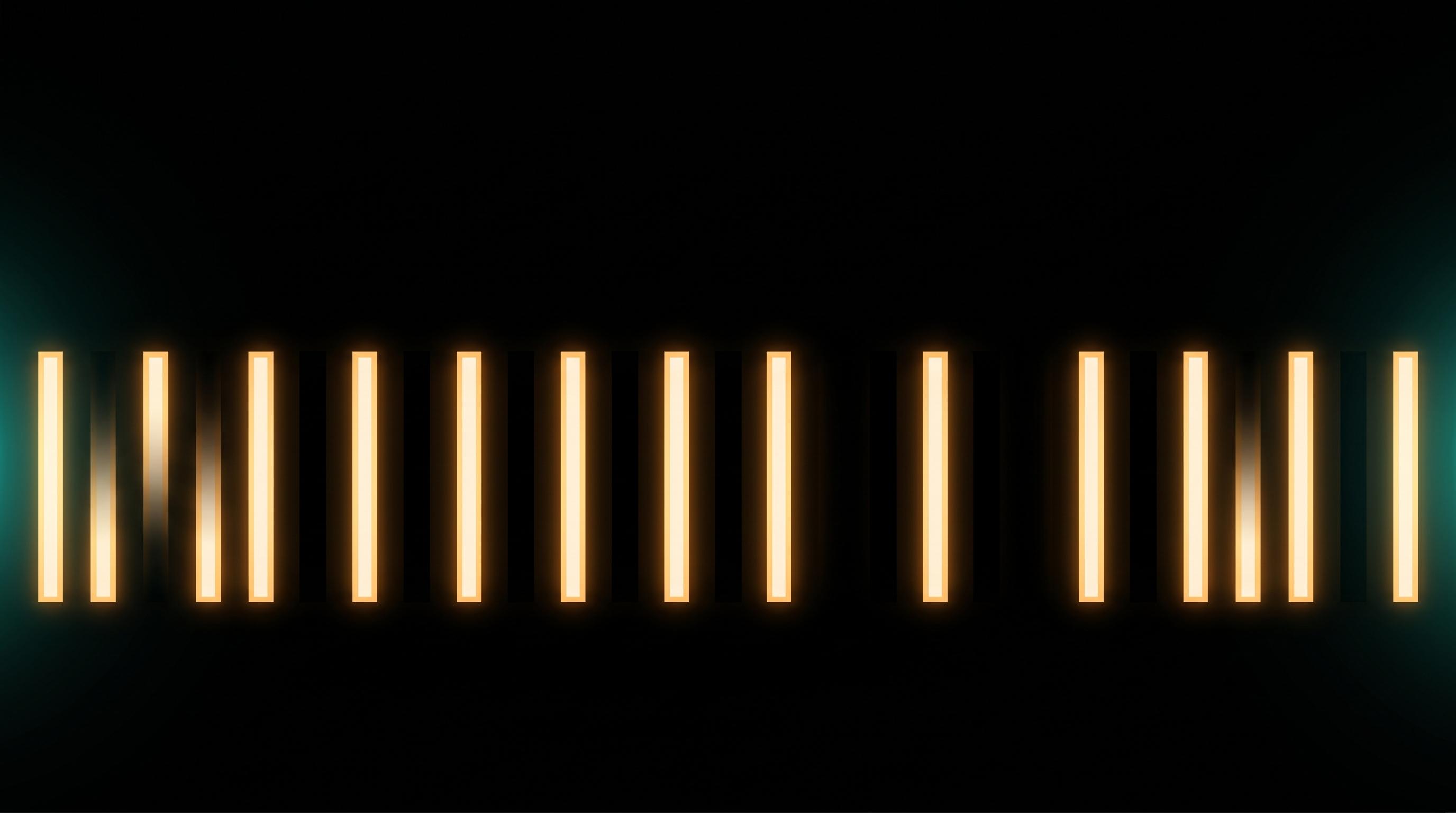
Isochronic tones are a single tone switched rapidly on and off, creating evenly spaced pulses of sound. That stark on–off rhythm produces the strongest measured brain-entrainment response of any common audio method — and unlike binaural beats, it works through speakers, with no headphones needed. The honest caveat: the technology is genuinely understudied, and the pulsing that makes it powerful is also what some people find distracting.
If you've explored binaural beats or colored noise, you've probably brushed past isochronic tones without a clear explanation of what they actually are. Here's the plain-English version — what they are, how they work, what the evidence does and doesn't support, and how to run a fair test on yourself.
What are isochronic tones?
An isochronic tone is one tone — a single frequency, like 250 Hz — turned on and off at a regular, rapid interval. Pulse it on and off ten times a second and you've created a 10 Hz rhythm built entirely from the contrast between sound and silence.
That's the whole idea. No second frequency, no phantom beat — just rhythmic interruption.
This is what sets isochronic tones apart from their cousins. Binaural beats need two slightly different tones, one delivered to each ear, so your brain perceives a third "beat" at the difference between them. Monaural beats blend two frequencies into a single channel before the sound reaches you. Isochronic tones skip all of that and rely on nothing but a tone clicking on and off.
If binaural beats whisper to your brain, isochronic tones speak clearly.
How do isochronic tones work?
The proposed mechanism is brainwave entrainment — also called the frequency-following response. The theory: rhythmic sound can gently nudge your brain's electrical activity toward the rhythm's frequency, encouraging states associated with focus, calm, or relaxation depending on the rate you choose.
Why does the on–off pulse produce such a strong signal? It comes down to modulation depth — how completely the sound switches between full volume and silence. The auditory steady-state response was first described by Galambos, Makeig and Talmachoff (1981, PNAS), who showed that tones repeated at around 40 per second produce a large, stable cortical response. Strong amplitude modulation drives that response; the gentle modulation underlying binaural beats does not drive it as hard.
One honest note before you read further: you'll see claims online that isochronic tones are "100,000× stronger" than binaural beats. Ignore that number — nobody has published it, and no source we can find supports any specific ratio. What the measurements actually show is that isochronic tones produce a larger evoked EEG response. A bigger brain-wave reading is not the same as a bigger real-world benefit. Stronger signal, not proven stronger outcome.
Isochronic vs binaural vs monaural beats
The three main brainwave-entrainment methods trade off in a predictable way — the stronger the measured signal, the thinner the research behind it:
| Method | How it's made | Headphones? | Measured signal | Evidence depth |
|---|---|---|---|---|
| Isochronic tones | One tone pulsed on/off | No | Strongest | Thin — a handful of small studies |
| Monaural beats | Two tones mixed into one channel | No | Strong | Limited |
| Binaural beats | A different tone in each ear | Yes | Subtlest | Deepest (Garcia-Argibay 2019, pooled g=0.45) |
The takeaway: binaural beats are the most-studied but produce the weakest evoked response; isochronic tones are the opposite — the strongest signal, the least research. For the full evidence picture on each, the complete binaural beats guide is a good next stop.
Do you need headphones for isochronic tones?
No — and that's their single biggest practical advantage.
Because an isochronic tone is just one tone pulsing on and off, it works perfectly through speakers. Nothing depends on sending a different frequency to each ear. That makes isochronic tones a natural fit for group settings, meditation studios, or anyone who finds headphones uncomfortable.
Binaural beats can't do this. They require headphones — without stereo separation, the effect collapses entirely. Isochronic and monaural beats are the headphone-free options.
If you want to test that claim right now, we run a free isochronic generator at isochronic.info — no signup. Play it out loud on your laptop speakers and you'll hear the pulse survive the room, which is the whole point.
What does the evidence actually say?
Thinner than almost anyone selling it will tell you. It is worth walking through precisely, because the gap between "measurable" and "proven" is where most of the marketing lives.
Start with what has actually been measured. The strongest single piece of evidence is Dos Anjos and colleagues (2024, Neuroscience), who recorded EEG from 28 participants across four minutes each of gamma binaural beats, isochronic-style tones, and white noise. Binaural beats and white noise both raised gamma-band power, as expected. The isochronic condition produced significantly greater changes in EEG power (p < 0.001), plus a distinct alpha-band pattern neither comparison produced.
Three caveats belong with that result, and they matter:
- It measures brain activity, not outcomes. Nobody in that study got more focused, slept better, or felt calmer as a measured result. Larger EEG power is a mechanism signal.
- n=28, four minutes per condition. That is a pilot-scale sample, not a trial.
- The authors describe their stimulus as a new form of auditory beat stimulation inspired by isochronic tones, and several are affiliated with a company commercialising it. That does not make the measurement wrong, but it is the kind of thing an honest reader should know.
Two claims used to sit in this article and no longer do. Earlier versions cited a "2025 study of 60 students" showing gamma isochronic tones beat beta and alpha for sustained attention, and said the neural effects "persist for minutes after the sound stops." We could not verify either against a primary source, so we cut both. If you have seen those claims elsewhere, including from us, treat them as unsupported until someone produces the paper.
Where does that leave things? There are no trials in clinical populations. There is no outcome evidence for sleep, anxiety or focus specific to isochronic tones. What exists is a real, replicated-in-principle mechanism (Galambos 1981) and one small modern comparison showing the mechanism is strongest for this stimulus type (Dos Anjos 2024). That is a reasonable basis for a low-risk personal experiment. It is not a basis for a health claim, and we won't make one.
Which frequencies are used, and for what?
Isochronic tones are tuned to the same brainwave bands as other entrainment methods. Match the pulse rate to your goal — but read these as convention and mechanism-reasoning, not as findings from outcome trials, because those trials do not exist yet:
- Gamma (~40 Hz) — alertness and sustained attention. The mechanism evidence is strongest here, and 40 Hz is the frequency Galambos originally characterised. 10–20 minute sessions.
- Beta (13–30 Hz) — active focus and engaged thinking. Often feels less intense than gamma. 10–15 minutes.
- Alpha (8–12 Hz) — calm, light relaxation. The best starting point if you're new to this. 15–20 minutes.
- Theta (4–8 Hz) — meditation and evening wind-down. 20–30 minutes.
- Delta (0.5–4 Hz) — theoretically relevant to sleep, and the least studied band of all. If you experiment here, expect no evidence to back you up.
Individual response varies more with isochronic tones than with subtler methods, so a short personal experiment beats following a rigid chart.
How to use them, by goal
For focus. Gamma (around 40 Hz) or beta, 10–20 minutes, before or during cognitively demanding work. Because isochronic tones work through speakers, you can run them in the background during the work itself — though many people find the pulsing distracting for reading- or writing-heavy tasks. Test your own tolerance before you rely on it.
For stress and relaxation. Theta (6–7 Hz) or alpha (around 10 Hz), 5–30 minutes, seated or reclined with eyes closed. The speaker compatibility makes isochronic tones genuinely practical for group relaxation, yoga classes or meditation spaces, where asking everyone to wear headphones isn't realistic.
For meditation. Theta or alpha, 15–30 minutes. The pronounced pulsing can act as a rhythmic anchor for attention — some meditators find it prevents mind-wandering, others find it intrudes on exactly the state they're trying to reach. There's no predicting which you'll be.
Try this tonight: a beginner's protocol
For focus: pick a 40 Hz gamma track, set a comfortable volume, and play it for 10 minutes before you start focused work. Afterwards, check whether task engagement felt easier and how long it took before your first real distraction.
For relaxation: find a quiet 15 minutes, choose a 10 Hz alpha track, and sit or recline with your eyes closed. Let the pulsing run without trying to force relaxation. At the end, check the physical markers — has your breathing slowed, have your shoulders dropped, has the mental chatter quieted?
For meditation: use a 6 Hz theta track through speakers, and meditate as you normally would with the pulse as background. Compare a few sessions with and without it before deciding.
Give any of these two weeks before you judge. If the pulsing is actively unpleasant in week one, that is your answer — some people simply don't get on with it, and there's no benefit worth enduring an irritant for.
Troubleshooting
"The pulsing is incredibly distracting." By far the most common complaint. Try embedding the tones in music or nature sound to soften the starkness, or drop the volume — they work at lower levels than most people expect. If it still grates, switch to binaural or monaural beats, which create much subtler rhythms.
"I can't tell whether it's working." Effects are subtle, particularly for attention. Track something objective: pages read or problems solved in a timed session, or how long until your first significant distraction. Subjective focus ratings before and after help too.
"How loud should they be?" A comfortable 50–70 dB. Rhythmic interruption is what matters, not intensity — volume adds nothing here.
A note on layering with noise
Here's a detail most guides miss, and one worth stating carefully because it is routinely overstated — including in earlier versions of this article.
The systematic review by Ingendoh, Posny and Heine (2023, PLOS ONE) looked at 14 binaural-beat studies and found the entrainment evidence inconsistent overall — five studies supported it, eight contradicted it, one was mixed. Within that, they noticed something specific: of the four studies that embedded binaural beats in pink noise, all four found no entrainment effect. The authors flag this as a pattern worth investigating, not as a demonstrated cause, and they do not examine brown noise at all.
So the honest version is: if you are chasing binaural entrainment specifically, layering pink noise on top is a plausible way to lose it, and running them in separate sessions is the cautious choice. Isochronic tones sidestep the question — the stark on–off pulse survives a low-level background bed where a subtle phantom beat would be masked. If you like an ambient layer, keep it quiet enough that the pulse stays clearly audible, and pick the right color for the job. Our colored noise breakdown covers which noise matches which goal.
Are isochronic tones safe, and who are they for?
For most people, isochronic tones are a safe, non-invasive thing to try. If you have epilepsy or a seizure disorder, consult a healthcare provider first — rhythmic auditory stimulation could theoretically act as a trigger. And as with binaural beats, don't use them while driving or doing anything that needs your full attention.
The bigger question is tolerance. The pronounced pulsing that makes isochronic tones powerful also makes them divisive: some people find the rhythm a steadying anchor, while others find it intrusive. There's no way to know which camp you're in without trying — at a comfortable volume, not a loud one.
Where DeepBliss fits
DeepBliss ships ten isochronic presets spanning delta to gamma, alongside binaural, monaural and colored-noise engines, so you can run the comparison this article keeps recommending without hunting for tracks. You can also layer isochronic tones under affirmations in your own cloned voice — the tones set the rhythm, the words carry the content. Given how much individual variation there is here, being able to change one variable at a time is most of the value.
The bottom line
Isochronic tones are the simplest entrainment method to explain and the strongest to measure. One tone, pulsed on and off, no headphones required. The mechanism goes back to Galambos in 1981 and the one good modern comparison (Dos Anjos 2024) puts the isochronic signal ahead of both binaural beats and white noise.
What's missing is everything after the EEG: no outcome trials, no clinical data, no evidence that a larger brain-wave reading makes you more focused or calmer. Add the fact that the pulsing genuinely annoys a sizeable minority of listeners, and the fair summary is a promising, low-risk experiment with an honest question mark over it.
So the useful question isn't "do isochronic tones work?" It's "do they work for you, and can you live with the pulsing?" Two weeks of paying attention will tell you more than any of the research currently can.
Important: This article is for educational and general wellness purposes only. Audio entrainment technologies are not medical devices and are not intended to diagnose, treat, cure, or prevent any disease. Individual results may vary significantly. If you have a diagnosed medical or mental health condition, please consult with your healthcare provider before using audio entrainment technologies.